Plastic stamping process: what it is and how it works

The plastic stamping process turns thermoplastic and thermosetting materials into finished parts using a press and a dedicated tool: a die that cuts the material, or a mould that shapes it. In this guide we explain how it works, which dies and moulds are used, which plastics can be stamped and how Idea Stampi approaches every project.

plastic stamping process

What is plastic stamping?

Plastic stamping is a manufacturing process in which a press uses a dedicated tool to turn plastic into a finished part. In industry, the term covers two different technologies:

  • Die-cut plastic stamping: a punch press and a die cut flat shapes, such as gaskets, washers and insulating spacers, out of sheets of plastic or other non-metallic materials. Presses are available in conventional and high-speed versions, with tonnages that vary according to the equipment.
  • Injection stamping (injection moulding): plastic granules are melted and injected under pressure into a mould, which gives the part its three-dimensional shape. This is the technology Idea Stampi specialises in, and the one used for complex, high-precision components.

In both cases, the quality of the result depends on the same three choices: the material, the tool and the process parameters.


Let’s plan your plastic stamping process together.

 Request a free quote

Which plastic materials can be used in the plastic stamping process?

Almost any thermoplastic can be processed through plastic stamping, from commodity polymers to high-performance technopolymers. The right choice depends on mechanical loads, operating temperature, chemical exposure, regulatory requirements and cost per part. The table below summarises the main materials used in the plastic stamping process and where they perform best.

Material

Key properties

Typical applications

PP (polypropylene)

Lightweight, chemically resistant, excellent fatigue resistance (ideal for living hinges), low cost

Caps and closures, containers, automotive interior parts

PE / HDPE (polyethylene)

Tough, resistant to moisture and chemicals, low friction

Containers, fittings, household and industrial parts

PS (polystyrene)

Rigid, dimensionally stable, transparent in its standard grade, low cost

Laboratory and medical disposables, packaging, housings

ABS

Rigid, impact resistant, excellent surface finish, easy to colour

Housings, console lids, appliance components

PC/ABS

Combines the heat and impact resistance of PC with the processability of ABS

Electronic enclosures, automotive interior parts

PC (polycarbonate)

Transparent, very high impact strength, good dimensional stability

Covers, lenses, medical device housings

PMMA (acrylic)

Outstanding optical clarity, UV and scratch resistant, rigid but more brittle than PC

Light guides, displays, lenses

POM (acetal)

High stiffness, low friction, wear resistant, dimensionally stable

Gears, bushings, clips, small mechanisms

PA6 / PA66 (nylon)

Strong and tough, wear resistant, often glass-fibre reinforced; absorbs moisture

Brackets, connectors, under-bonnet components

PBT

Good electrical insulation, dimensional stability, chemical resistance

Connectors, electrical components, sensor housings

PPO (modified polyphenylene oxide)

Low water absorption, dimensional stability, good dielectric properties, hydrolysis resistance

Pump housings, water-handling and electrical parts

PPA (polyphthalamide)

High-temperature polyamide that keeps stiffness and chemical resistance under heat

Automotive under-bonnet parts, fluid handling

PPS

High temperature and chemical resistance, inherently flame retardant, very stable dimensions

Electrical, automotive and pump components

PEI

High heat resistance, inherently flame retardant, strong, suitable for repeated sterilisation

Medical, aerospace and electrical components

PEEK

Superpolymer with very high temperature and chemical resistance, biocompatible grades, ideal for metal replacement

Medical, aerospace, high-performance industrial parts


At Idea Stampi we mould all these technopolymers and superpolymers, regardless of their classification, including the most demanding projects in PEEK injection moulding.


Materials for die-cut plastic stamping

Flat die-cut parts are usually stamped from sheets. The most common options are:

  • Vulcanised fibre: made from cellulose, strong for its weight, resistant to impact and abrasion, a good electrical insulator.
  • Laminates such as G-10/FR4: glass-reinforced epoxy rated by NEMA grades for mechanical and electrical performance.
  • Thermoplastic sheets: PP, HDPE and LDPE, PTFE, acetal and nylon, chosen for chemical resistance, low friction or toughness.

Why choose a plastic injection process for your project?

Injection stamping is the right choice when you need three-dimensional parts with complex geometries, tight tolerances and repeatable quality across large runs.

Rapid injection stamping leverages production automation: the 3D models go straight to the toolroom, where mould milling begins. For prototypes and short runs, moulds can be made of aluminium instead of steel, allowing faster and more cost-effective tooling; hardened steel moulds remain the reference for long, high-volume series.

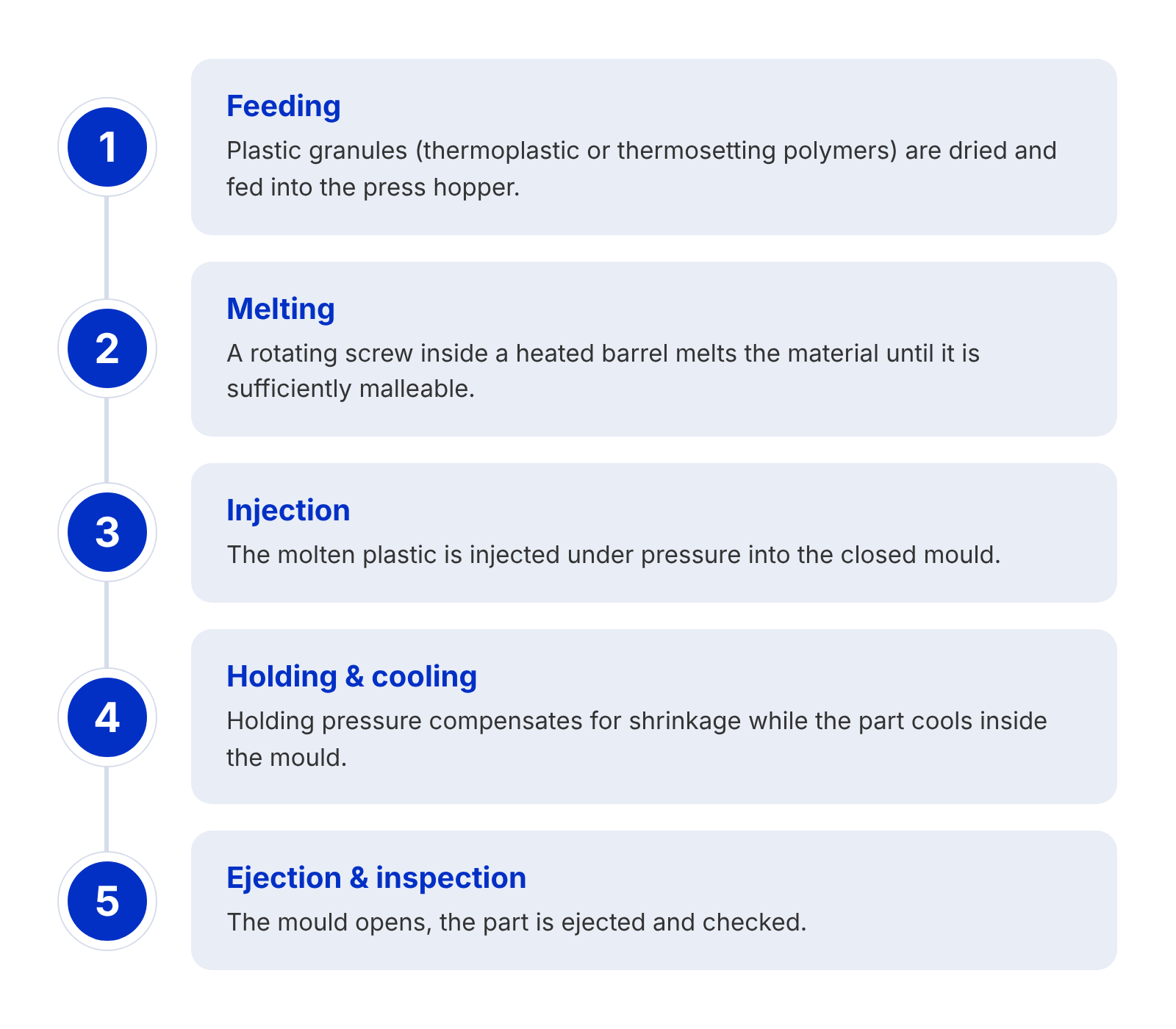
How the plastic injection stamping process works

Five steps turn plastic granules into a finished, inspected part.

injection process


Need a reliable partner for plastic stamping?

 Ask for an estimate without obligation

Which dies and moulds are used in plastic stamping?

The tool is the heart of plastic stamping: it defines the geometry of the part, its tolerances, the cycle time and, ultimately, the cost per piece. Here are the main types, for each of the two technologies.


Dies for die-cut plastic stamping

  • Compound dies: cut the outer profile and punch the internal features in a single stroke. They are the most common choice for precise flat parts such as washers and gaskets; high-pressure air then clears the excess material.
  • Progressive dies: a strip of material advances through a sequence of stations, each performing one operation. They suit high-speed, high-volume production.
  • Steel rule dies: a hardened steel blade bent to the required shape and set in a base. A low-cost option for thin, soft materials and short runs.


Moulds for plastic injection stamping

  • Single-cavity moulds: produce one part per cycle. Lower tooling cost and maximum control, ideal for large parts, prototypes and low volumes.
  • Multi-cavity moulds: produce several identical parts per cycle, reducing the cost per piece on high volumes. Find out more about multi-cavity moulds and how they compare with single-cavity tools.
  • Family moulds: produce different parts of the same assembly in a single cycle.
  • Cold runner and hot runner moulds: hot runner systems keep the plastic molten in the channels, reducing waste and cycle time; cold runner moulds are simpler and more flexible when materials or colours change often.
  • Insert and overmoulding moulds: allow metal inserts, or a second material, to be moulded directly onto the part, cutting assembly steps.

Which tools are used in the plastic stamping process?


plastic-stamping-process


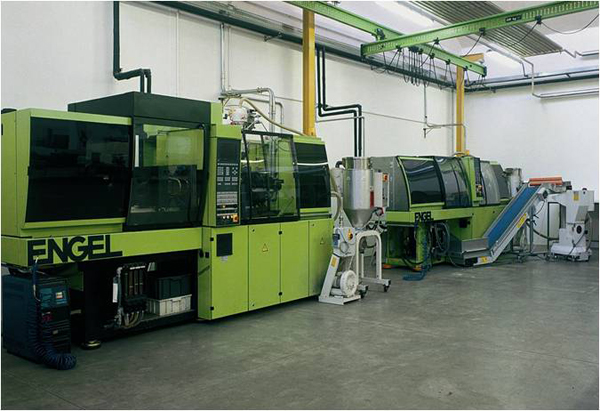
At Idea Stampi, the plastic stamping process runs on Engel, Arburg and Fanuc injection presses, recently joined by new presses and an automated production island in an enlarged production area. Machines, materials and moulds are chosen around your part, because technology counts, but method makes the difference: every project is calibrated on your needs to ensure stable, 100% Made in Italy quality.

Alongside precision injection moulding, our equipment allows us to offer:

  • Screen printing
  • Pad printing
  • Assembly of components

What products can the plastic stamping process be used for?

The plastic stamping process is used to make a huge variety of everyday products. Look around, at work or at home, and you will find injection-moulded parts everywhere: bottle caps, remote control housings, console lids, syringes, gears and connectors.

In industry, plastic stamping is essential for sectors where precision and reliability over time are non-negotiable:

  • Medical: device housings, disposables, orthodontic components.
  • Automotive: technical parts, interior components, under-bonnet parts.
  • Electrical and electronics: connectors, enclosures, insulating components.
  • Aerospace and metal replacement: lightweight high-performance polymer parts that replace metal.

Plastic stamping services by Idea Stampi

Choosing a plastic stamping partner means choosing how your project will be analysed, built and controlled over time. At Idea Stampi, reliability is a choice and speed is its consequence. Here is what we bring to every project:

  • Moulds designed and built in-house: we design and build our moulds in-house and support existing parts with reverse engineering based on optical scanning.
  • Expertise in technopolymers and superpolymers: from PP and ABS to PEI, PPS and PEEK, we choose the material with you, starting from how the part must perform.
  • Clean room and temperature-controlled area: controlled environments for medical and high-precision components.
  • A complete service: screen printing, pad printing, assembly and laser welding for mould repair, managed by a single partner.
  • Experience and stability: in Rovereto since 1986, part of the Fluid-o-Tech Group, with 100% Made in Italy production.
  • A structured technical dialogue: every project starts with a technical discussion, because complexity cannot be simplified, it must be governed.


Do you want to know if Idea Stampi is the right partner for your plastic stamping project?

 Contact us for a free quote